
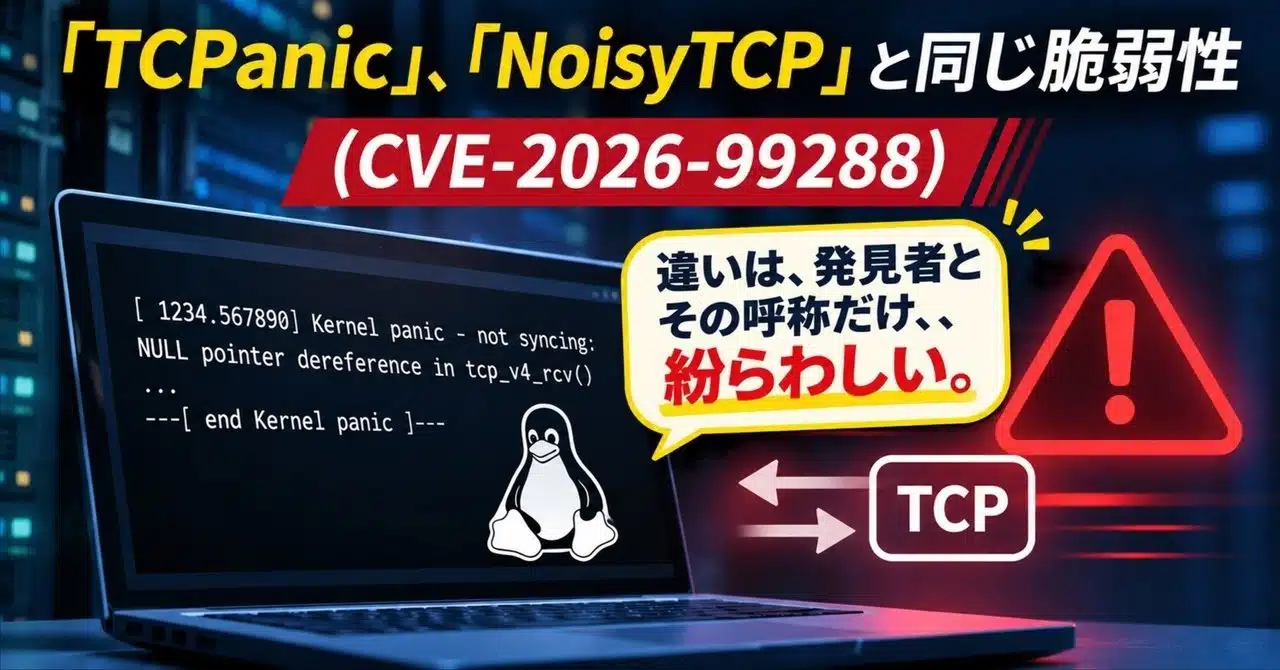
On November 27, 2026, Japanese security firm Ikotas Labs announced TCPanic, a vulnerability in the Linux kernel’s TCP processing. The issue is also known as NoisyTCP and is tracked as CVE-2026-99288; the two names refer to the same vulnerability.
TCPanic can allow a remote attacker to trigger a kernel panic using TCP traffic, potentially taking down an entire Linux server. It requires no application login or authentication. The vulnerability affects both IPv4 and IPv6. A remote code execution impact has not been confirmed, but a proof of concept has demonstrated a kernel panic.
Linux identifies TCP connections using a combination of source and destination IP addresses and port numbers. To handle network traffic efficiently, the kernel can process socket lookups across multiple CPUs.
TCPanic is caused by a race condition during this concurrent processing. One CPU may look up a socket while another frees it or reuses its memory. Under particular timing conditions, the first CPU can then access an invalid socket and encounter a null pointer dereference, causing a kernel panic.
The issue is in the Linux kernel, not in software such as Apache or nginx. Updating applications alone will not fix it.
Any Linux service that accepts TCP connections could potentially be affected, including web servers, SSH, mail and database servers, VPNs, load balancers, and network appliances.
A normal TCP connection does not necessarily cause a crash. Exploitation depends on factors such as the kernel version, the traffic reaching the server, concurrent processing across CPUs, and whether the vulnerable processing path is reached. No application-level authentication is needed, so controls such as SSH public-key authentication or web-server login requirements do not prevent the kernel-level issue.
The key question is where the TCP connection terminates.
If internet traffic reaches a Linux server directly through a firewall or NAT, permitted packets are processed by the server’s kernel. HTTPS does not protect against the issue because TCP processing occurs before TLS.
When an application load balancer terminates the client’s TCP connection and establishes a separate connection to the backend, the client’s TCP packets do not reach the backend kernel unchanged. This is expected to reduce the risk of direct attacks from the internet. However, operators should verify that the backend has no direct access path and assess possible attacks from internal networks. Load balancing does not remove the need to patch the backend kernel.
L4 load balancers need to be assessed according to how they handle connections. NAT or direct server return (DSR) may allow packets to reach the backend, while a full TCP proxy that terminates and independently re-establishes connections can isolate the backend from the direct attack path.
A typical WAF inspects HTTP traffic and cannot prevent a vulnerability in TCP processing. If it acts as a reverse proxy and terminates TCP connections, that connection separation may help protect the backend.
Docker and Podman containers share the host’s Linux kernel. If traffic to one container triggers a kernel panic, other containers on the same host may also go down. Similarly, a kernel panic on a Kubernetes worker node can affect all Pods running on it.
Updating container images is not a fix. The kernel on the container host or Kubernetes worker node must be updated.
Upstream Linux releases listed as containing the fix include:
Linux distributions may backport fixes to older kernel versions, so the major version alone is not enough to determine whether a system is vulnerable. Check the relevant distribution’s security advisory and installed kernel package.
If a patched package is not yet available, Red Hat identifies two possible mitigations:
Disable SYN cookies. This avoids the processing path associated with the vulnerability, but weakens protection against SYN-flood attacks. The setting can be checked with cat /proc/sys/net/ipv4/tcp_syncookies; disabling it temporarily requires sudo sysctl -w net.ipv4.tcp_syncookies=0. The setting is per network namespace, so container namespaces may need separate checks.
Reduce parallel network receive processing. Limiting receive queues and disabling mechanisms such as RPS and RFS may reduce the race condition opportunity. This can also lower throughput, concentrate load on a CPU, increase packet drops, or disrupt communications during reconfiguration. Validate the effect before applying changes to high-traffic systems.
Network controls can also reduce exposure: minimize publicly accessible ports, restrict administrative access, disable unnecessary TCP services, prevent direct access to backend servers, and use a proxy that terminates TCP connections where appropriate. These measures reduce risk but do not replace a kernel update.
Useful checks include:
uname -rcat /etc/os-releasess -lntpcat /proc/sys/net/ipv4/tcp_syncookiesnprocKernel panic logs from a prior boot can be reviewed with:
journalctl -k -b -1Messages involving a kernel panic, null pointer dereference, or TCP receive functions may be relevant, but they do not by themselves prove that TCPanic caused the incident. Persistent logs, crash dumps, and external logging can help with investigation.
TCPanic is primarily an availability threat rather than a confirmed information-disclosure or remote-code-execution vulnerability. Its potential to crash an operating system without authentication makes it important for infrastructure teams, but exposure varies with network design and kernel configuration. Assess the actual traffic paths and trade-offs of temporary mitigations, then install a patched kernel as soon as one is available.
ChicagoVPS is your gateway to unparalleled hosting solutions. Our state-of-the-art datacenters and powerful network ensures lightning-fast speeds and uninterrupted connectivity for your websites and applications. Whether you’re a startup looking for scalable resources or an enterprise in need of enterprise-grade hosting, our range of plans and customizable solutions guarantee a perfect fit. Trust in ChicagoVPS to deliver excellence, combining unmatched reliability and top-tier support.
For Inquiries or to receive a personalized quote, please reach out to us through our contact form here or email us at sales@chicagovps.net.


