
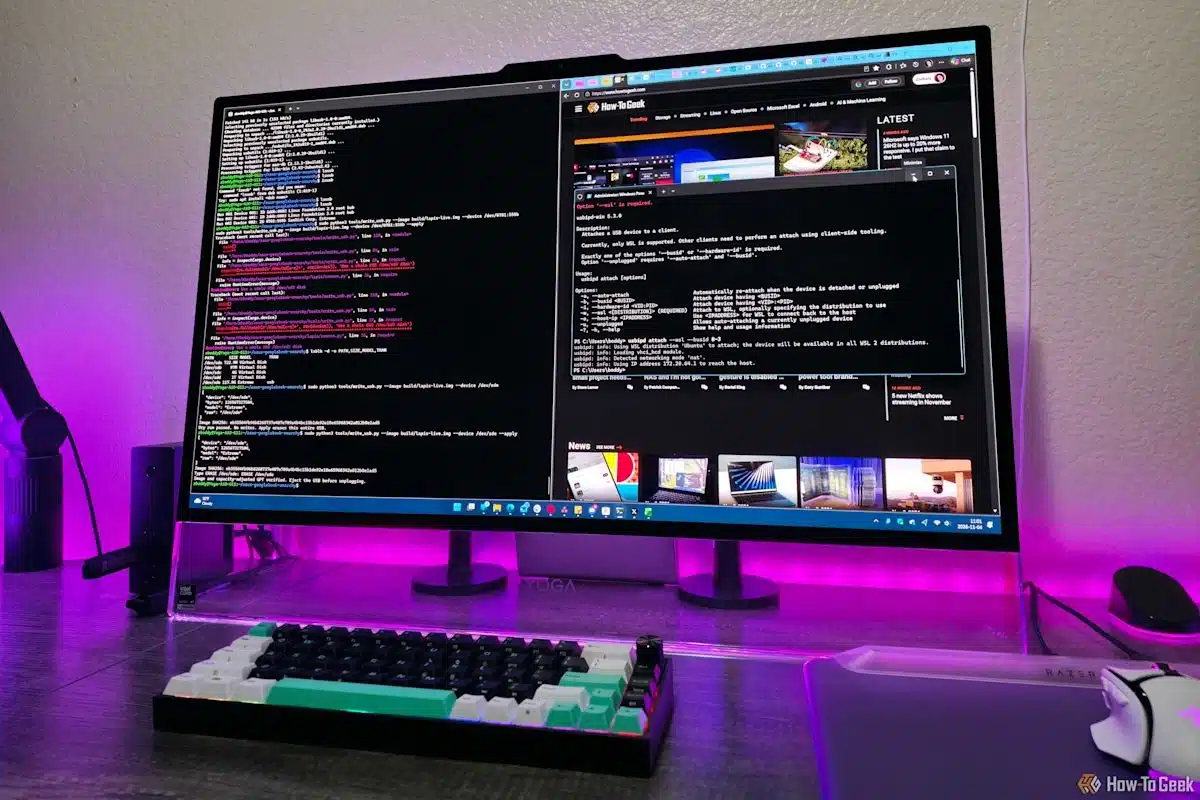
Linux was as fast as—or faster than—Windows 11 in a series of everyday-use tests, though the comparison was informal and involved several differences in hardware and software.
The test used a dual-boot desktop with Windows 11 installed on a faster NVMe drive and CachyOS Linux on a slower SATA SSD. Windows had Copilot disabled, while CachyOS used an optimized kernel and the lightweight Xfce desktop. Those factors make the results specific to this setup, rather than a definitive comparison of the operating systems.
From the bootloader to the login screen, Windows took 19 seconds to start. CachyOS took 20 seconds, despite running from the slower drive, making boot times essentially equal.
At idle, Windows used about 6GB of the system’s 12GB of RAM. CachyOS with Xfce used roughly 1.5GB, or around 3.5GB when accounting for cached data. Switching to the experimental COSMIC desktop added about 500MB. Idle memory use doesn’t directly measure performance, but it illustrates the difference in background resource consumption.
CachyOS opened Chrome and loaded Google’s homepage in 1.88 seconds, compared with 3.16 seconds on Windows.
Steam also launched faster on Linux: 22.87 seconds on CachyOS, versus 32.94 seconds on Windows. The test used Chrome from Arch Linux’s AUR and Steam from Arch’s multilib repository, so results may differ with other software packages or installation formats.
In this setup, Linux matched Windows in boot time and started the tested applications faster, even though it was installed on slower storage. But the difference wasn’t especially noticeable in ordinary use on this desktop. The comparison was not scientific, and the optimized Linux kernel and lightweight desktop may have helped CachyOS.
The gap could be more meaningful on older computers. A 2011 Toshiba laptop that struggled after an upgrade to Windows 10 became usable again after switching to Linux, with additional improvements from adjusting KDE Plasma settings.
The test did not cover gaming performance. Linux gaming has improved, and some games may perform better through Valve’s Proton compatibility layer, but that would require separate testing.
Overall, Linux can feel faster, particularly on older or resource-constrained hardware, but the benefits depend on the computer, software, and configuration.
ChicagoVPS is your gateway to unparalleled hosting solutions. Our state-of-the-art datacenters and powerful network ensures lightning-fast speeds and uninterrupted connectivity for your websites and applications. Whether you’re a startup looking for scalable resources or an enterprise in need of enterprise-grade hosting, our range of plans and customizable solutions guarantee a perfect fit. Trust in ChicagoVPS to deliver excellence, combining unmatched reliability and top-tier support.
For Inquiries or to receive a personalized quote, please reach out to us through our contact form here or email us at sales@chicagovps.net.


